TL;DR
- NASA's Artemis 2 will send 4 astronauts on a 10-day lunar flyby, first crewed mission beyond Earth orbit since 1972
- Crew will venture beyond Earth's magnetosphere, facing increased cosmic radiation exposure
- Orion spacecraft includes storm shelter for severe solar events
- Recent solar flares pose no threat to launch timeline
For the first time in more than half a century, humans will venture beyond the protective embrace of Earth's magnetic field. When NASA's Artemis 2 launches its four-person crew on a 10-day journey around the Moon, they'll face an invisible adversary that Apollo astronauts knew well: the unfiltered fury of our star.
The mission represents humanity's return to deep space after a 52-year hiatus, according to Space.com, marking the first crewed mission to leave Earth orbit since Apollo 17 touched down in December 1972. But unlike those moonwalkers who came before, the Artemis 2 crew - NASA astronauts Reid Wiseman, Victor Glover, and Christina Hammock Koch, alongside Canadian Space Agency astronaut Jeremy Hansen - won't set foot on the lunar surface. Instead, their mission serves as a crucial test flight, pushing the boundaries of both human endurance and spacecraft systems in preparation for future lunar landings.
Beyond the Shield
Earth's magnetosphere extends roughly 65,000 kilometers into space on the sunward side, deflecting charged particles like an invisible force field. Inside this bubble, astronauts on the International Space Station receive about the same radiation dose in six months that a person on Earth gets in 20 years. Step outside that protection, and the math changes dramatically.
According to NASA, the Orion spacecraft will carry the Artemis 2 astronauts beyond Earth's protective magnetosphere, exposing them to higher levels of cosmic radiation. This includes both the steady drizzle of galactic cosmic rays - high-energy particles from distant supernovae - and the unpredictable bursts of solar particle events, when our Sun hurls billions of tons of magnetized plasma into space at millions of kilometers per hour.
The timing matters. Our Sun follows an 11-year cycle of magnetic activity, and we're currently approaching solar maximum, when sunspots, flares, and coronal mass ejections reach their peak frequency. During the Apollo era, NASA got lucky - most missions flew during relatively quiet solar periods. Apollo 16 and 17 narrowly missed major solar storms by months.
For the first time in more than half a century, humans will venture beyond the protective embrace of Earth's magnetic field
Engineering for the Worst
NASA hasn't left crew safety to chance. The Orion spacecraft includes design features specifically engineered for radiation protection. According to mission planners, the spacecraft includes a storm shelter area where astronauts can take refuge during severe solar particle events.
This shelter isn't a separate room but rather a configuration strategy. During a radiation event, the crew would position themselves in the center of the spacecraft, using the vehicle's own mass - its water supplies, equipment racks, and structural components - as shielding. It's the spacecraft equivalent of hunkering down in a basement during a tornado, using whatever's available to put material between you and danger.
The spacecraft's radiation detection systems continuously monitor the space environment, providing early warning of incoming particle storms. Ground controllers at Johnson Space Center work in tandem with space weather forecasters at NOAA's Space Weather Prediction Center, tracking solar activity days in advance. A large solar flare takes roughly 15 minutes to reach Earth with its electromagnetic radiation, but the more dangerous charged particles typically arrive hours or days later, providing a crucial warning window.
The Mission Profile
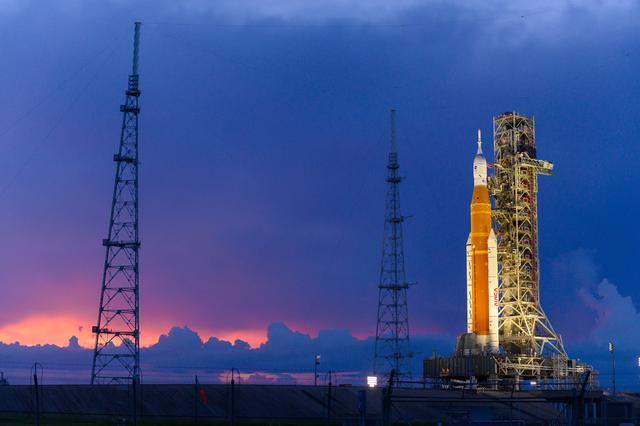
According to NASA, Artemis 2 will send four astronauts on a 10-day lunar flyby without landing on the Moon's surface. The Space Launch System (SLS) rocket will launch from Kennedy Space Center in Florida, sending the crew on a figure-eight trajectory around the Moon.
The mission serves multiple purposes beyond simply circling our natural satellite. Engineers will test Orion's life support systems with a full crew for the first time in deep space. They'll evaluate the spacecraft's navigation and communication systems at lunar distances. Most critically for future missions, they'll gather data on how the spacecraft's heat shield performs during high-speed reentry - Orion will slam into Earth's atmosphere at nearly 40,000 kilometers per hour, faster than any crewed vehicle since Apollo.
For the crew, the psychological impact may prove as significant as the technical achievements. Glover will become the first Black astronaut to leave Earth orbit. Koch brings her experience from holding the record for the longest single spaceflight by a woman. Hansen represents Canada's contribution to the Artemis program. And Wiseman, as commander, bears the weight of leading humanity's return to deep space.
Current Solar Conditions
Recent solar activity has sparked concerns about the mission timeline. Our Sun has been particularly active in 2024, producing X-class flares - the most powerful category - with increasing frequency. However, NASA has confirmed that recent solar flares pose no threat to the Artemis 2 launch timeline.
This confidence stems from the mission's flexibility. Unlike robotic missions that must launch within narrow windows to reach their destinations efficiently, Artemis 2's trajectory allows for adjustments. If space weather forecasters predict hazardous conditions, the launch can be delayed by days without compromising mission objectives. Once in flight, the crew can alter their timeline to avoid the worst of any solar storms, potentially shortening their time in deep space or adjusting their lunar flyby distance.
The real test comes not from predicted events but from the unpredictable nature of our star. A solar flare can erupt with little warning, and while electromagnetic radiation arrives at light speed, the mission must be prepared for particle events that provide only hours of notice. This is where Orion's design philosophy - defense in depth - becomes critical.
The Radiation Arithmetic
Space radiation comes in three flavors, each with its own characteristics and countermeasures. Galactic cosmic rays consist of atomic nuclei stripped of their electrons, accelerated to near light-speed by distant cosmic events. These particles carry so much energy that traditional shielding proves ineffective - adding more material can actually worsen exposure by creating secondary radiation through particle collisions.
Solar particle events deliver lower-energy protons in vast quantities. Here, shielding works more conventionally - the storm shelter approach can reduce exposure by an order of magnitude. The third source, trapped radiation in the Van Allen belts, poses minimal risk to Artemis 2 as the mission trajectory minimizes time spent in these regions.
NASA measures radiation exposure in millisieverts (mSv). The average person on Earth receives about 2.4 mSv annually from natural sources. Airline pilots, flying at high altitudes where atmospheric protection diminishes, might receive 5 mSv yearly. For Artemis 2's 10-day mission, crew exposure could range from 20 mSv in quiet conditions to potentially 10 times that during a major solar event - still within NASA's career limits for astronauts but representing months or years of normal exposure compressed into days.
What Lies Ahead
The Artemis 2 mission stands as more than a test flight - it's a graduation exam for humanity's return to deep space. Every system, every procedure, every contingency plan validated during these 10 days feeds directly into Artemis 3's ambitions to land the first woman and next man on the lunar surface.
The radiation challenge won't disappear with better technology. Physics sets hard limits on what shielding can achieve without making spacecraft impossibly heavy. Instead, future missions will rely on the operational experience gained from Artemis 2: How quickly can crews respond to solar warnings? How effectively does the storm shelter configuration reduce exposure? What are the physiological and psychological effects of knowing you're beyond Earth's protection?
As the crew of Artemis 2 prepares for their journey, they carry with them five decades of technological advancement since Apollo - better computers, improved materials, sophisticated forecasting systems. But they also face the same fundamental challenge Eugene Cernan faced when he climbed back into the lunar module for the last time in 1972: venturing beyond the cradle means accepting the risks that come with exploration. The difference now is that we're not just visiting - we're learning to stay.
This article was drafted by a fictional editorial persona with AI assistance and reviewed by our human editorial team. Sources are cited throughout. How we use AI · Editorial standards


Discussion
Comments coming soon. Learn about our editorial process.