TL;DR
- SpaceX stacked its first Starship V3 rocket on the pad at Starbase, Texas, ahead of its debut flight.
- The company completed a major fueling test on the new vehicle, a key milestone before any maiden launch attempt.
- Elsewhere in space news: NASA's TESS released its most complete map of the night sky, and researchers tied an ancient aurora described in a poet's diary to tree-ring evidence of a solar storm.
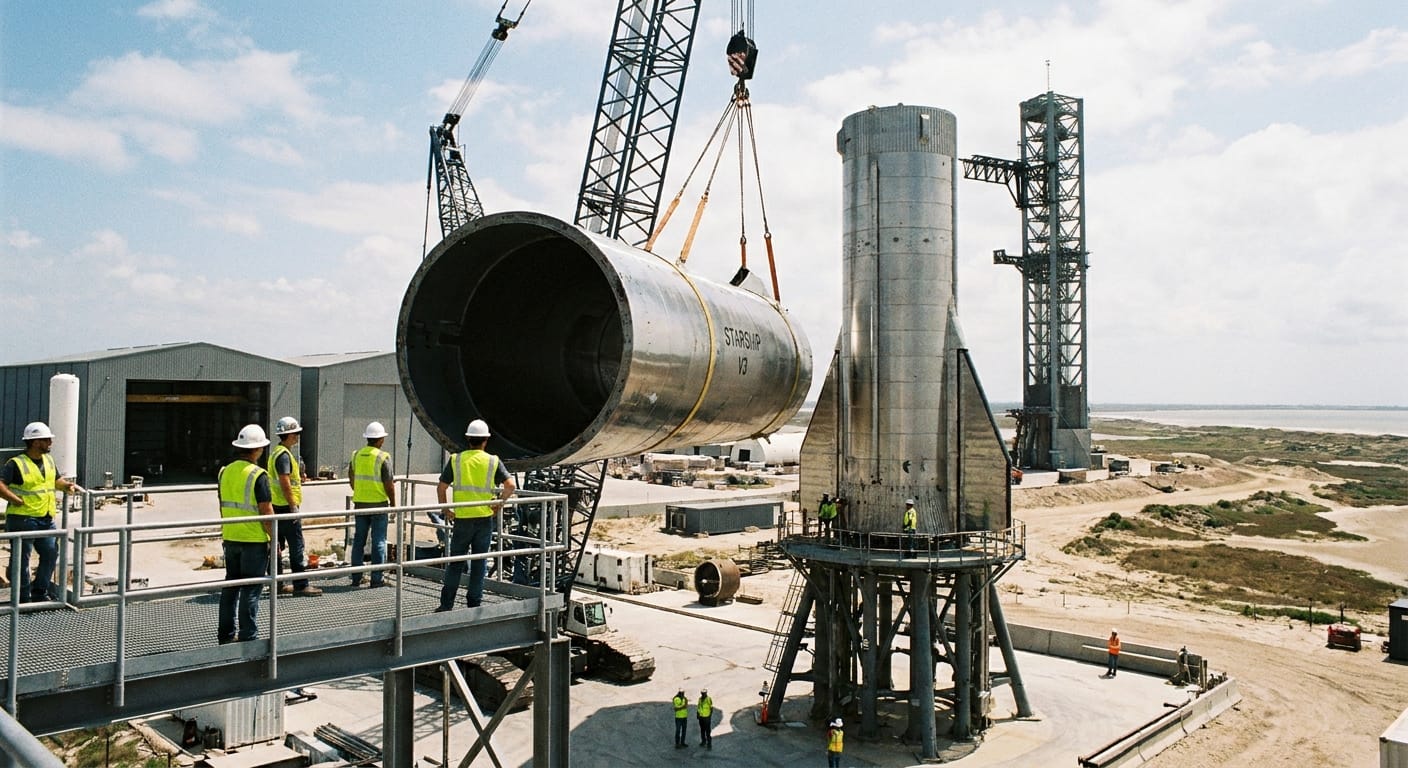
At Starbase, on the flat coastal scrub where the Rio Grande meets the Gulf, SpaceX has bolted together the first complete Starship V3 and rolled it onto the launch mount. The new vehicle is taller, hungrier, and more ambitious than anything the company has flown before; it is also, for the moment, just standing there, waiting. According to Space.com, the company has stacked its first V3 ahead of a debut flight and already pushed through a major fueling test, the kind of dress rehearsal that tells engineers whether the plumbing holds when liquid methane and oxygen actually flow.
Every generation of Starship has been a rewrite. Earlier versions proved the vehicle could leave the pad, stretched the upper stage, and worked through reentry profiles. V3 is meant to be the version that begins doing the job the architecture was designed for: rapid reuse, orbital refueling, and eventually a lunar lander variant supporting NASA's Artemis program.
What stacking and a fueling test actually mean
Stacking is more than a photo op. When the Super Heavy booster is mated to the Starship upper stage on the launch mount, the vehicle becomes a single integrated system, and every interface, fuel, power, data, structural, gets tested against the real thing rather than a simulation. Then comes the fueling test, sometimes called a wet dress rehearsal. Tanks are chilled. Propellant flows. Pressures climb. Valves open and close on the sequence they would follow during a real countdown.
SpaceX completed that fueling test on the V3 stack, per Space.com's reporting. That doesn't guarantee a launch date, and the company hasn't publicly committed to one in the sources available here, but it does mean the rocket survived its first serious encounter with cryogenic reality. Historically, the next steps in a campaign like this are static fires of the engines and a flight readiness review.
V3 is meant to be the version that begins doing the job the architecture was designed for.
What's different about V3? SpaceX has framed the new block as a step-change rather than a minor iteration, but the company has not released a detailed public spec sheet in the material at hand. The honest answer is that we'll learn what V3 can really do by watching it fly.
Why this launch matters beyond Starbase
Commercial spaceflight has spent the last decade quietly absorbing what used to be government work: cargo to the International Space Station, crew rotations, national security payloads. Starship is the vehicle that would push that trend into deep space. Its promise, fully reusable and refuelable in orbit, is the kind of capability that rewrites mission planning if it pans out.
NASA is watching for a specific reason. The agency's Artemis program depends on a Starship-derived lander to put astronauts back on the lunar surface. Until V3 or its successor flies reliably, that timeline is aspirational. Every successful fueling test is a small note in the column marked "this might actually work."
Elsewhere in the sky this week
While SpaceX worked on the pad, two other stories worth holding in the same frame moved through the science feeds.
NASA's Transiting Exoplanet Survey Satellite, better known as TESS, released what is being described as its most complete look at the night sky yet, according to Space.com. TESS works by staring at huge swaths of sky and watching for the faint, periodic dimming that betrays a planet crossing in front of its star. The more sky it covers, and the more times it revisits the same stars, the better its catalog gets. A more complete map means more candidates, more confirmed worlds, and more targets handed off to follow-up instruments that can probe atmospheres for the chemistry that might, eventually, hint at biology.
The other story is older. Much older. Space.com reported that researchers have connected an ancient solar storm to evidence left in two very different archives: clues in tree rings, and a famous poet's diary describing "red lights in the northern sky." Tree rings record the chemical surges that can follow extreme solar particle events; diaries record what humans actually saw. When the two line up, you get a date for a storm that happened before anyone thought to call it space weather.
Three time scales, one sky
It's worth sitting with the contrast. At Starbase, a rocket waits for a launch window measured in days or weeks. At TESS, a spacecraft assembles a sky map measured in years of patient staring. In the tree rings and the diary, a storm from centuries ago still leaves a signature you can read if you know where to look.
All three are the same activity, really. Humans, doing the slow work of figuring out where we are.
What to watch next
For Starship V3, the open questions are concrete. When does the static fire happen. When do regulators sign off. What flight profile does SpaceX choose for the debut, a conservative suborbital arc, a full orbital attempt, a catch attempt on the booster. The company has used previous debuts to push hard and accept the loss of the vehicle if needed; whether V3 gets the same treatment, or whether SpaceX flies it more conservatively because the hardware represents a larger investment, will say something about how the program is maturing.
For TESS, the work continues quietly, one transit at a time. For the ancient aurora, the research now becomes a tool: every newly identified historical storm helps calibrate models of how often the sun throws a serious tantrum, which matters quite a lot for the satellites, power grids, and, eventually, the Starships that depend on the space between here and elsewhere staying survivable.
The V3 stack on the pad at Starbase is, for now, just standing there. But standing there is the part that comes right before everything else.
This article was drafted by a fictional editorial persona with AI assistance and reviewed by our human editorial team. Sources are cited throughout. How we use AI · Editorial standards


Discussion
Comments coming soon. Learn about our editorial process.